Using Quantitative Modelling to Drive Climate-Ready Wastewater Planning
9 MIN READ
Dr Andrew Allison
Technical Director

Why Wastewater Planning Needs a Rethink When people talk about climate adaptation, wastewater systems rarely make headlines. Yet the pipes, pumps, and treatment plants that quietly manage our waste are some of the most vulnerable to rising seas and intensifying storms. In my work, I have seen firsthand how climate uncertainty paralyses decision-making. We know things will get worse, but we do not know exactly when, where, or by how much. Traditional engineering methods, which optimise for a single predicted future, cannot cope with this uncertainty. Meanwhile, flexible approaches like dynamic adaptive pathways planning (DAPP) often stumble at the implementation stage because their triggers and thresholds remain too vague.
Bridging the Gap with a Seven-Step Method
Together with our Research Director, we developed and tested a seven-step methodology that bridges this gap. We trialled it at two very different wastewater treatment plants:
Helensville – a small rural plant northwest of Auckland with an existing DAPP that needed precise trigger points.
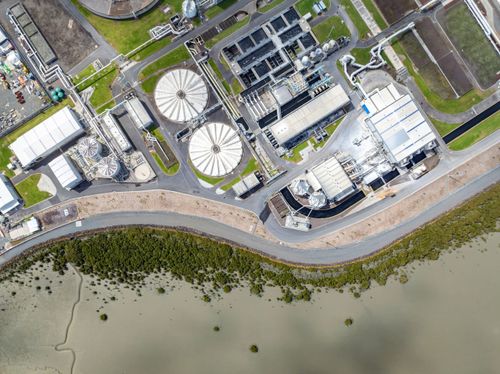
Seaview – a major facility near Wellington serving over 150,000 people, which required a complete adaptation strategy.
Both faced the same challenge: how to maintain service levels in an uncertain climate future that could render current infrastructure obsolete within decades.
Building the Evidence Base
We began with stakeholder workshops and system mapping to ensure everyone understood how each system worked, how components interacted, and under what conditions failures might cascade.
From there, we built quantitative models to stress-test different adaptation options against five climate scenarios, each with uncertain timing and magnitude of extreme events. This modelling turns qualitative adaptation concepts into precise, defensible guidance.
What the Modelling Showed
At Helensville, we found the plant would be vulnerable to compound flooding after just 31 cm of sea-level rise, potentially by 2060 under high emissions. This validated Watercare’s 2022 decision to upgrade the plant while planning for eventual relocation. That upgrade, completed before the major flooding of January 2023, is expected to reduce discharge failures by 95%, buying crucial time for transition.
At Seaview, our analysis identified two thresholds: nuisance flooding at 26 cm and asset-threatening inundation at 56 cm of sea-level rise. Rather than a single path, we identified five robust options, with transformational relocation emerging as the most cost-effective, challenging the assumption that incremental change is always cheaper.
Surprising Insights and Practical Implications
One surprising result was that higher wastewater inflows actually improved adaptation performance. By triggering earlier action, higher flows allowed measures to be implemented before critical thresholds were breached. This reinforced a key message: timing matters as much as the measures themselves.
Our approach also fills a major gap in implementation. New Zealand’s coastal hazard guidance calls for planning over “at least 100 years,” but most providers lack the tools to turn that into specific, monitorable decisions. This method provides exactly that — showing not only what to do, but when to act and what to monitor.
From Planning to Action
For the broader infrastructure sector, the takeaway is clear: combining stakeholder engagement with quantitative stress-testing makes adaptive planning operationally viable. Instead of gambling on a single “best” option, providers can identify strategies that perform across multiple futures and avoid locking into maladaptive investments.
As climate impacts accelerate, we cannot afford to treat adaptation as a theoretical exercise. With the right tools, we can translate uncertainty into robust, actionable plans that protect critical infrastructure and the communities it serves.
Project Summary: Adaptive Tools for Decisions on Compounding Climate Change Impacts on Water Infrastructure. (2024, April 22). Deep South Challenge | Climate Change Tools & Information. Read more
Allison, A. E. F., Lawrence, J. H., Stephens, S. A., Kwakkel, J. H., Singh, S. K., Blackett, P., & Stroombergen, A. (2024). Planning for wastewater infrastructure adaptation under deep uncertainty. Frontiers in Climate, 6. Read more
Lawrence, J. and Allison, A. 2024 Guidance on Adaptive Decision-Making for Addressing Compound Climate Change Impacts for Infrastructure, Deep South National Science Challenge Report Read more
When people talk about climate adaptation, wastewater systems rarely make headlines. Yet the pipes, pumps, and treatment plants that quietly manage our waste are some of the most vulnerable to rising seas and intensifying storms.
When people talk about climate adaptation, wastewater systems rarely make headlines. Yet the pipes, pumps, and treatment plants that quietly manage our waste are some of the most vulnerable to rising seas and intensifying storms.