From exposure to action: introducing the Asset Risk Table in Resilience Explorer®
2 MIN READ
Dr Ria Edmonds
Product Manager

Knowing that an asset is exposed to flood risk is not the same as knowing what to do about it. For asset managers and infrastructure planners working across large portfolios, the harder question has always been: of everything at risk, where do we act first?
Until now, answering that question in Resilience Explorer® required a workaround. Risk results were visible on the map, and a colour-coded consequence layer could show which assets were most affected. But if you wanted to see which of your portfolio of 3,000 buildings had the highest inundation depth, or filter a roading network to see only those with the highest consequence under a particular climate scenario, you had to export the data and do that analysis in a spreadsheet outside the platform.
That gap mattered. The strength of Resilience Explorer® as a decision platform is that it brings together hazard, exposure, vulnerability, and consequence in one place. Pushing users out to a spreadsheet to complete a basic prioritisation task broke that workflow at exactly the moment it counted most.
What the Asset Risk Table does
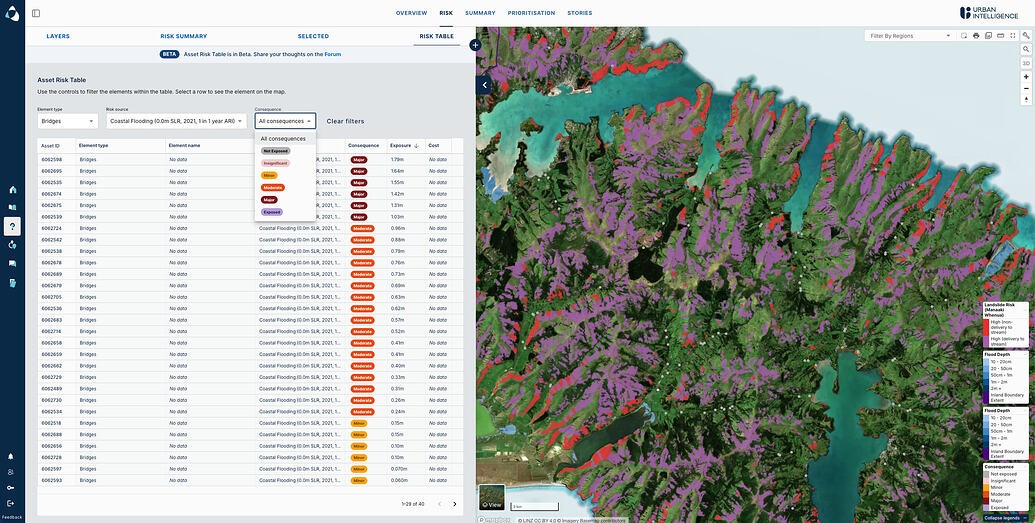
The Asset Risk Table is a new tab in the Resilience Explorer® side panel, sitting alongside the existing Risk Summary and Selected views. It replicates the underlying risk database as a live, sortable, filterable table within the platform.
Users can sort and filter across any combination of asset type, hazard, consequence, and exposure. Clicking any row in the table takes you directly to that asset on the map. The two views stay connected, so moving between a ranked list and the spatial context it sits within is seamless.
For a council asset manager running a long-term plan review, that means being able to identify the highest-consequence roads, buildings, or utilities in a catchment area and jump straight to the map context without switching tools. For an infrastructure planner building a capital investment case, it means being able to filter by hazard and consequence to surface the assets that most need attention.
Why this matters for infrastructure planning
The pressure to make climate and natural hazard risk decisions defensible is growing. Long-term plan obligations, XRB climate disclosure requirements, and NPS-NH guidance all require organisations to demonstrate that investment priorities are evidence-based. Ranking assets by risk, and being able to show that ranking clearly, is central to meeting that standard.
Risk results that live only on a map are difficult to present in that context. A table, sorted by consequence, with the ability to drill into any asset and see its full risk profile, is a format that governance teams, boards, and regulators can engage with directly.
The Asset Risk Table does not add new data or new modelling. It surfaces what Resilience Explorer® already calculates in a form that is easier to act on.
Beta release: now live
The Asset Risk Table is in beta and available and live for all Resilience Explorer® clients at no additional cost. The design is still being refined, and this is the best time to shape it. If something is missing from your workflow, we want to hear about it.
If you want to talk through how the Asset Risk Table fits your planning or reporting workflow, reach out to your relationship manager directly. They can walk you through the feature and make sure you are getting the most out of it.
From exposure to action: introducing the Asset Risk Table in Resilience Explorer®
Knowing that an asset is exposed to flood risk is not the same as knowing what to do about it. For asset managers and infrastructure planners working across large portfolios, the harder question has always been: of everything at risk, where do we act first?